|
|
|||||
|
Maximizing biogas production |
Hammarby Sjöstadsverk was 2008 jointly taken over by KTH Royal Institute of Technology
and IVL Swedish Environmental Research Institute with wastewater treatment lines
in pilot plant scale (150 p.e. = 1,5 m3/hour): ·
Aerobic treatment with activated
sludge process and sedimentation. ·
Aerobic treatment with membrane
bioreactor (MBR), an aerobic reactor with submerged micro filter, and
drum filter for separation of primary sludge. ·
Anaerobic treatment with UASB-reactors
(Upstream Activated Sludge Blanket). ·
The produced sludge can be thickened, digested and dewatered. Activated sludge MBR UASB and sludge digesters |
||||
|
|
Erik Levlin |
||||
|
40%: |
Dep. of Land
and Water Resources Engineering, Royal S-100 44 |
||||
|
20%: |
Hammarby Sjöstadsverk, IVL Swedish Environmental Research Institute, |
||||
|
E-mail: levlin@kth.se |
|||||
|
Keywords: pilot plant,
biogas production, nutrient removal, phosphorus recovery
|
|||||
|
Global warming
Global
warming can be counteracted by substituting fossil fuel with biogas from
digesting sewage sludge, thus reducing climate impact from carbon dioxide
emissions. A challenge for future development of wastewater treatment is that
demands on effluent quality, especially for nitrogen removal, can come in
conflict with the desire of a high production of biogas, since maximising the amount produced biogas yields less carbon
source available for nitrogen removal (Levlin,
2010). During biological nitrogen removal in activated sludge, half of the
organic content is oxidized to carbon dioxide and the produced sludge is less
degradable for biogas production. Digestion of the organic content in the
wastewater can give 80 % conversion to biogas (Kepp
and Solheim, 2000). Biogas is more easily produced
from primary sludge than from excess sludge from activated sludge process
with biological nutrient removal. Primary sludge is easily bio-degradable
since it consist of more easily digestible carbohydrates and fats, compared
to excess sludge which consists of complex carbohydrates, proteins and long
chain hydrocarbons (Gary et al., 2007). In the activated sludge process is
half oxidized and of the half remaining in sludge is about 40 % converted to
biogas, which gives that about 20 % of the organic content of the wastewater
is transformed to biogas. Development of new methods for nitrogen removal
without carbon source would give a large increase of biogas production from
Swedish wastewater treatment. |
Increased
biogas production Project at Hammarby Sjöstadsverk At Hammarby Sjöstadsverk a project for increased biogas production
from digestion of sludge has started. The idea is to dewater digested sludge
and recycle it back to the digestion. By making the sludge retention time
longer than the hydraulic retention time more biogas can be produced with the
same reactor volume. Since methane producers grow more slowly the long sludge
retention time makes the process more stable and biogas production is
increased. Another idea to study is to hydrolyze the sludge through ozonation. Recycling and ozonation
can give 80% sludge reduction (Yasui et al., 2005). Ozonation is a method that mostly is used for
reducing sludge volume, but has also been studied for achieving increased
biogas production. Ozone treatment has two counteracting effects. Partial destruction
of the microbial sludge cells and degradation of undegradable
molecules and cell structures will give an increased amount of dissolved
organics and higher biodegradability of the sludge increases the biogas
production. However, oxidation of organic material that is degradable may
decrease the biogas production. |
|||
|
Phosphorus
recovery The phosphorus content
in the digested sludge can be recovered by acid leaching and used as
fertilizer in the agriculture. Experiments with leaching inorganic sludge
residues with acid and base showed that the high amount of leached phosphorus
and the relatively lower amount of leached metals obtained at acid leaching
together with the low cost for acid makes acid leaching the most favourable and less expensive alternative (Levlin, 2006). To dissolve one mole phosphate three
equivalent of acid is required independent of to that metal the phosphate is
connected. The dissolved amount of metal shows that mainly metal phosphates
have been dissolved and that other metal compounds have remain
undissolved. However, the dissolved metals and
anions from the acid have to be separated from the phosphate in a second
process step. If the separation is done with ion exchange the minimum amount
of chemicals for leaching and regeneration will be six mole
acid and three mole base per mole phosphate. An alternative method is to mix
the sludge with balls of cation exchange material.
The ion exchange material will realise hydrogen
ions, take up metal ions and only phosphate will be dissolved. The ion
exchange material is regenerated with acid and the minimum amount of
chemicals will be three mole acid per mole phosphate. |
Anaerobic treatment without carbon source With anaerobic treatment a very high biogas production
can be achieved, however, without possibility for biological nutrient
removal. Reverse osmosis for nutrient removal has been studied (Kieniewicz, 2006), but the energy consumption is very high.
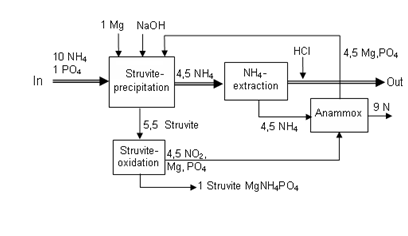
A process based on struvite (magnesium ammonium
phosphate, MgNH4PO4) precipitation with magnesium
and the anammox reaction
have been proposed for nutrient removal without need of carbon
source (Levlin, 2009). Half of the ammonia
content in the sewage water exceeding the phosphate content is extracted
as ammonia and the rest as struvite. By oxidizing
ammonia in struvite to nitrate, the |
|||
|
Cost estimation: Acid leaching and separation with ion exchange. Minimum need of
chemicals per mole FePO4 is 6 mole HCl (0.03 Skr/mole) and 3 mole NaOH (0.10 Skr/mole). Minimum
need of NaOH at basic leaching is 3 mole per mole FePO4 + 1 mole per mole Al. Combined leaching and metal separation with use of ion
exchanger. |
|
References Kepp, U. and Solheim, O.E. (2000) Thermo dynamical assessment of the
digestion process, 5th European Biosolids and
Organic Residiuals Conf. November 2000, Kieniewicz, A. (2006) A reverse osmosis
(RO) plant for sewage treatment and nutrient recovery - the influence of pre-treatment
methods. Master thesis, Levlin,
E. (2010) Maximering av slam och biogasproduktion för att motverka global
uppvärmning Vatten
66(1):
67-73. Levlin, E. (2009) Nutrient removal
without carbon source for achieving maximum biogas production and phosphorus
recovery. IWA 2nd Spec. Conf. Nutrient Management in Wastewater Treatment
Processes. Levlin, E. (2006) Phosphorus recovery
with acid and base from inorganic sewage sludge residues. IWA Spec. Conf. -
Sustainable sludge management. Yasui, H., Komatsu, K., Goel, R., Li, Y.Y. and Noike,
T. (2005) Full-scale application of anaerobic digestion process with partial ozonation of digested sludge Wat.
Sci. Tech. 52(1-2), 245-252. http://www2.lwr.kth.se/personal/personer/levlin_erik/eindex.htm
http://www.kth.se/abe/om-skolan/organisation/inst/see/om/avd/lwr/grupper/va-teknik |
||